🌩️ When the cloud goes down: how Commvault helps you design a provider-independent Disaster Recovery strategy
The AWS outage was a reminder that no platform is infallible. Here’s how Commvault enables you to design a disaster recovery plan that makes your company cloud-agnostic and capable of restoring critical services in minutes.
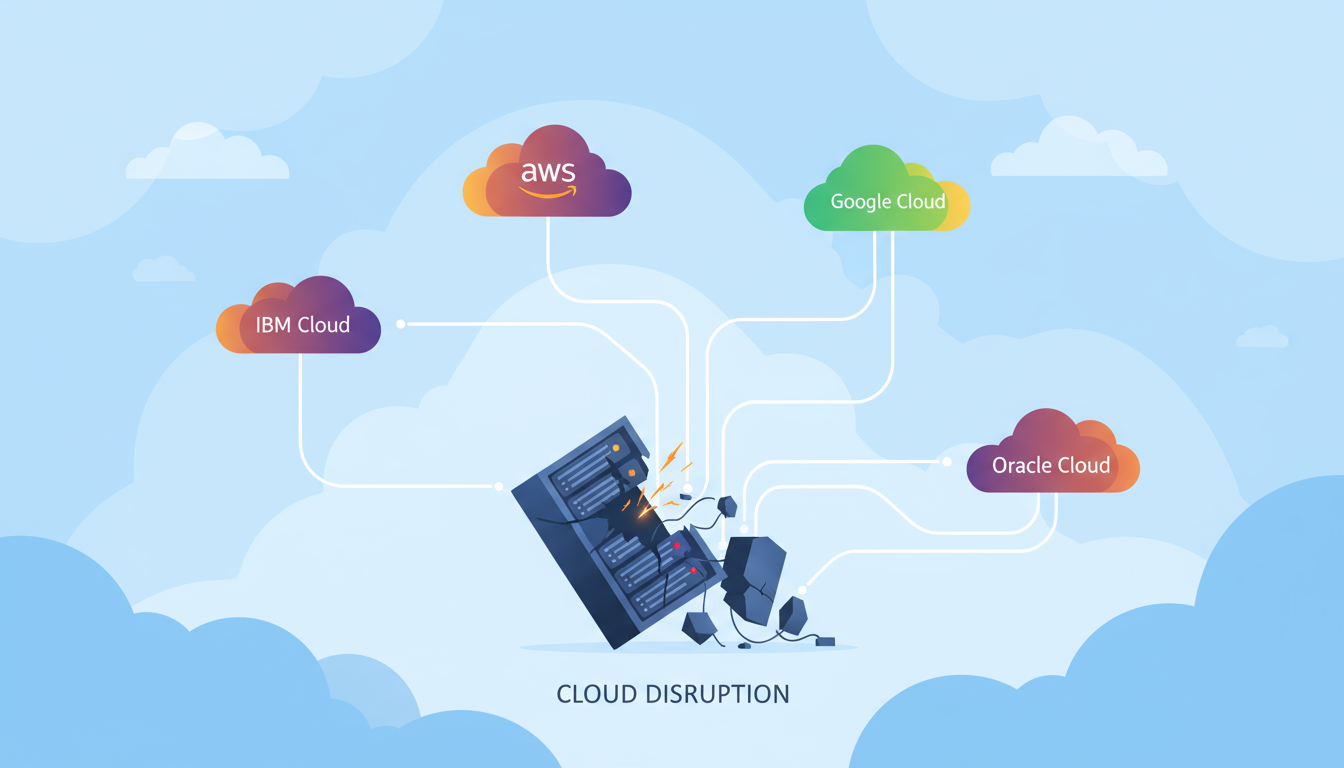
What the AWS outage made clear
Today (October 20, 2025), thousands of companies went offline due to a major AWS outage. Websites, e-commerce platforms, and applications stopped working because they depended on a single provider. The AWS outage once again proved an uncomfortable truth: no cloud is infallible.
At AT Vault, we see these events as reminders of a simple reality: the cloud can also fail. The good news is that there are ways to keep your business from coming to a halt during a crisis like this.
The problem with technology dependency
Many organizations use a single platform for everything (AWS, Azure, or Google Cloud). That initial simplicity comes with a hidden risk: a single point of failure. When a major outage occurs, organizations lose not only access to data and applications, but also sales, reputation, and customer trust.
Commvault and the power of agnostic disaster recovery
Commvault protects data, virtual machines, and applications in any environment: on-premises, cloud, or multicloud.
It enables you to design a truly independent multicloud environment. You can back up and restore your data across different clouds —AWS, Azure, Google Cloud, Oracle Cloud, or even your own data center— without changing your processes or losing information.
Its strength lies in backup portability and recovery automation, enabling you to:
| Benefit | Description |
|---|---|
| 🧭 Workload mobility | Replicate and restore your services across clouds (AWS, Azure, Oracle Cloud, or Google Cloud). |
| ⚙️ Full automation | Plan preconfigured recovery workflows to restore environments in minutes. |
| 🧱 Granular protection | Recover only the necessary components (website, database, or application). |
| 🌐 Provider independence | Avoid technology lock-in and choose where to run your infrastructure based on your strategy. |
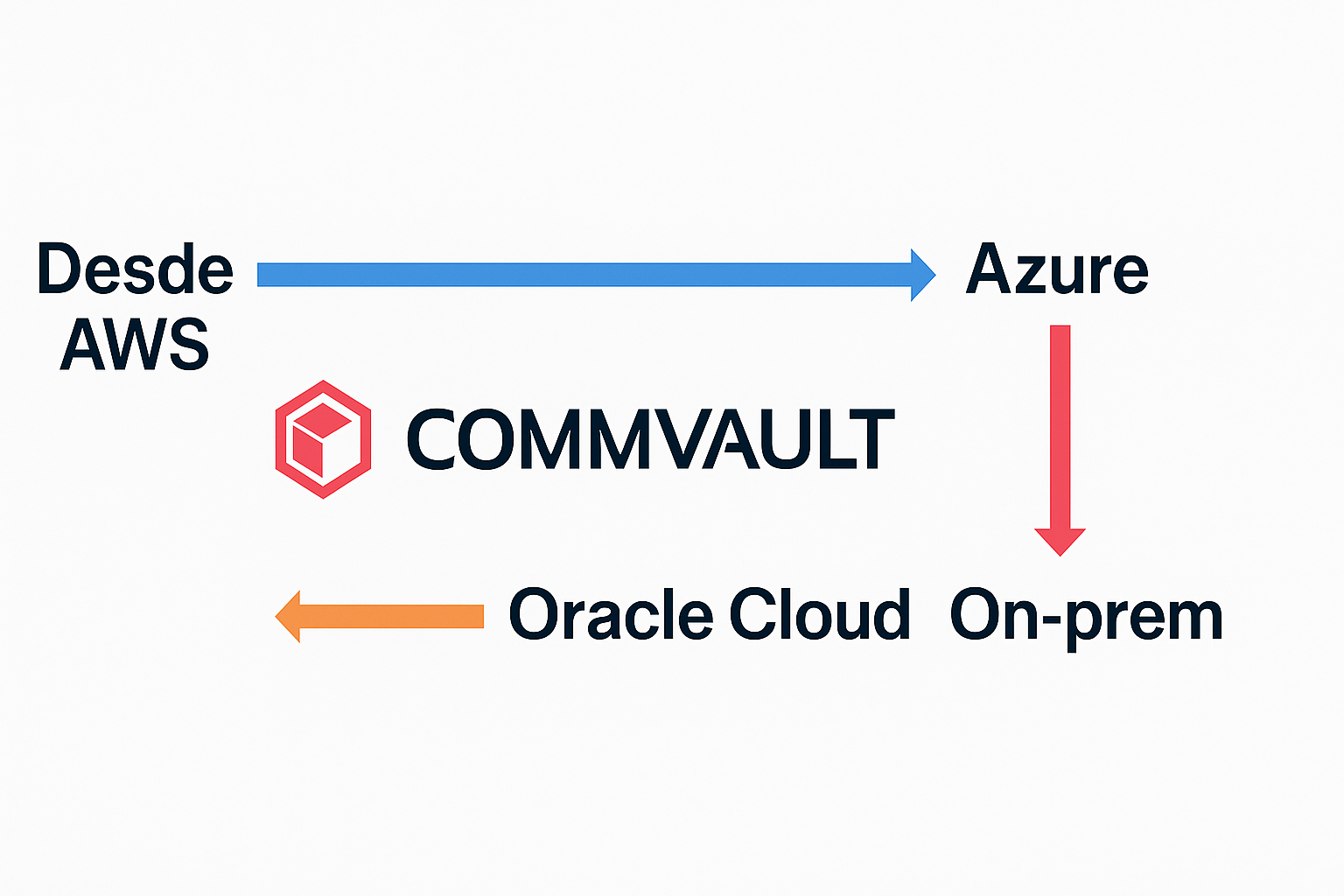
From AWS → Azure → Oracle Cloud → On-premises
Practical example
Imagine your ecommerce site is hosted on AWS and, suddenly, the platform experiences a global outage. With Commvault, you could bring up a replica in Azure or Google Cloud in a matter of minutes. Your customers would continue buying without noticing the difference, and you would gain something even more valuable than uptime: trust.
Practical guide: how to prepare your continuity plan with Commvault
- Assess your risks: identify which services you cannot afford to have go down.
- Define recovery objectives: establish your RTO (maximum recovery time) and RPO (maximum acceptable data loss).
- Automate recovery: configure failover workflows between clouds or between your data center and the cloud.
- Test your plan: run disaster recovery simulations at least twice a year.
- Document and monitor: use Commvault’s centralized reports to maintain visibility and meet compliance requirements.
A culture of continuity: more than technology
Resilience is not bought, it is built.
Commvault is the tool, but mindset is what makes the difference.
SMBs that plan for continuity do more than survive an outage: they become more competitive, because they operate with confidence and predictability.

Real-time dashboard
The decision that does not depend on any cloud
Technology disruptions are inevitable, but disasters are not.
Outages on platforms like AWS are not a remote possibility, but an eventual certainty. The difference between a disruption and a successful recovery lies in having a multicloud disaster recovery strategy with Commvault. That way, your company becomes truly technology-agnostic, resilient, and prepared to keep operating without interruptions.
Frequently asked questions
What is an agnostic disaster recovery strategy?
It is one where your recovery capability does not depend on the provider experiencing the outage: backups and recovery orchestration live outside the failure domain, and you can bring services up in another cloud or site.
Do I need to duplicate my entire infrastructure in another cloud?
No: for most organizations, replicas of critical systems and orchestrated recovery are enough — you pay for storage, not idle duplicate infrastructure. The DRP defines what each level requires.
How often should a continuity plan be tested?
Targeted restores every quarter, full recovery of a critical system every six months, and an annual drill with assigned roles. A plan without a test date on the calendar is just wishful thinking.
Commvault solution
Protect your data: Disaster recovery
Enterprise backup, ransomware recovery and business continuity.
Want a recovery strategy that doesn't depend on a single provider?
We design a backup and disaster recovery strategy tailored to your business and your clouds. The initial assessment is free.
Go deeper
How to Put Your First AI Agent into Production in 30 Days
The four-week plan we use with clients: choose the use case, build the knowledge base, connect the channel, test with r…
GuideHow to Build a Knowledge Base That Helps an AI Agent Respond Accurately
There is an uncomfortable truth about AI agents: 80% of the outcome depends on the information you provide, not the tec…
Case studyHow We Work: Vaulty + Time Tracker in a Multi-Client Operation
How we organize our multi-client operation with Vaulty and Time Tracker: task board, team workload, skills, and client…
Keep reading
How a Company Improved Its Oracle Cloud Backups with Commvault
A client running virtual servers on Oracle Cloud Infrastructure replaced its native backup tool with Commvault. It now…
SalesforceHow to Migrate from Workflows and Process Builder to Flows in Salesforce
Salesforce is positioning Flow as its primary tool for declarative automation. In this guide, we explain why you should…
SalesforceSalesforce Sales Cloud and Lead Management: How to Turn Leads into Real Opportunities
With Salesforce Sales Cloud, you can automatically centralize, qualify, and assign leads, preventing contacts from slip…